Introduction:-
There is a place where India meets Tibet, a route passes through the beautiful mountains of the great Himalayas. This route once connected Sikkim of India to Lhasa in Tibet. Along this route, shrouded in clouds, are many beautiful locations that were once part of the famous route known as “Silk route”.
Silk Route:-
This route facilitated not just trade between the two countries, but also fostered the exchange of thoughts, culture, and nature. The vibrant life of this region is exemplified by the pictures villages of Sikkim. However, many visitors coming to east Sikkim are unaware of this route, as it is a lesser known part of India bordered by Tibet on one side and the magnificent mountains of Bhutan on the other. Travelers heading to Tibet via the Silk route. Will encounter a village nestled among the clouds, known as “Zuluk”.
Zuluk:-
At a height of 10,000 feet, Zuluk village is surrounded by lush green mountains and is home to a few selected houses that seem to converse with the clouds. In fact, Zuluk is known as the gateway to the Silk route, as it was the first village where Silk route tourism began. The greenery, the graceful dance of the clouds, and the temperature is comfortably cold. The houses are not congested, allowing for some space between them. And the visible clouds, combined with the abundant greenery, create a stunning combination. It is incredibly peaceful, and I feel very close to nature. I find it hard to focus on the camera in front of me, instead, I am captivated by the clouds behind me.
Zuluk is somewhat nestled in a valley, where the altitude decreases sharply, creating a beautiful downward slope. The valley view in Zuluk is truly stunning. The greenery is not just limited to outside but lovely flowers can also be seen planted in the houses, which the residents take care of with great love.
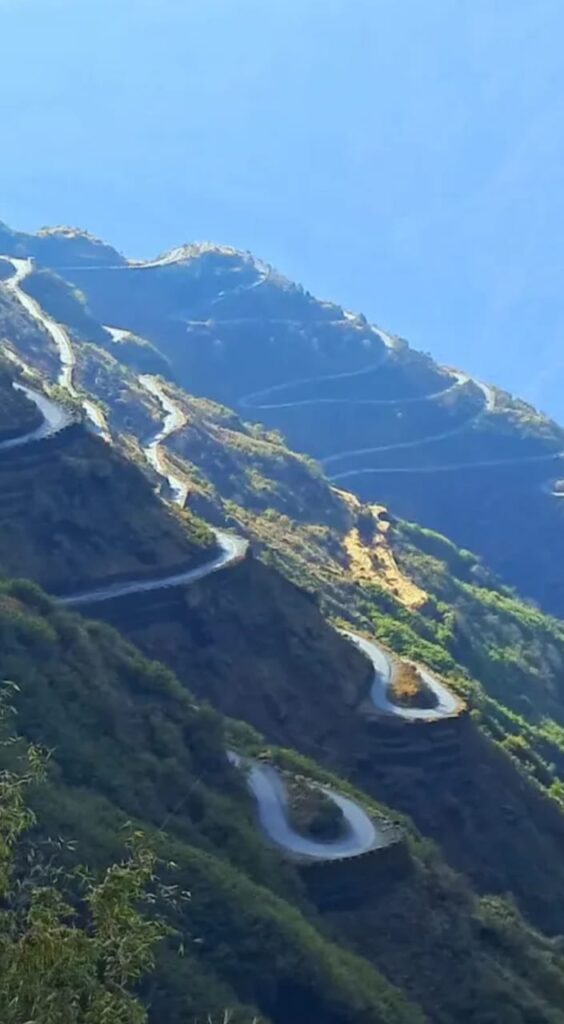
The most interesting thing about Zuluk is its winding path, a zigzag road surrounded by clouds. This road features approximately 32 hairpin bends and resembles a snake due to the rapid increase in altitude as you travel to Zuluk village. Because of this challenging terrain, such zigzag roads had to be constructed here. Another fascinating aspect is that this road follows part of the old Silk route, which is why it is also famously known as the Silk road.
This zigzag road, known as the Silk road, is not the actual Silk road. However, there is a historical trail ran though this area and remnants of it can still be seen today. Trere are patches of stones along the route where horses used to travel that is the real Silk road, the real Silk route. The zigzag road was constructed by the army during the war with China in 1962. It was built to accommodate heavy vehicles, including tanks, ammunition, and weapons. At that time this zig zag road was built to accommodate heavy vehicles. The original Silk route, however, was not a road at all until before the China war. It had existed long before that conflict and for many years prior.
This story of the Silk route goes like this, many years ago, China established a trade route to transport silk, spices, and various other goods to the west. Traders would load their goods onto horses and sell them from one location to another. Since silk was a major commodity traded along this route, it became known as the Silk route. One significant section of this route connected Lhasa in Tibet via Jelep Le pass to Nathang and Zuluk in East Sikkim, and it reached the sea ports of West Bengal. This route further linked to various countries via see ports. People traveling from Tibet often used the villages of Sikkim as stopping points or transit locations, which made these villages an important part of the Silk route. Today, theses villages are connected by a paved road, but they are still considered a part of the historical Silk route. The road has changed over the years, but the views remain just as beautiful today, enhanced even further by the clouds resting on the mountains. One thing that stands out after observing the weather here is that it rains a lot. And to protect themselves from this rainwater, some creative solutions, or “Jugaad”, can be seen on the roofs of the houses.
On the winding paths of Zuluk, lies one of the highest villages in Sikkim, known as “Nathang”.
Nathang:-
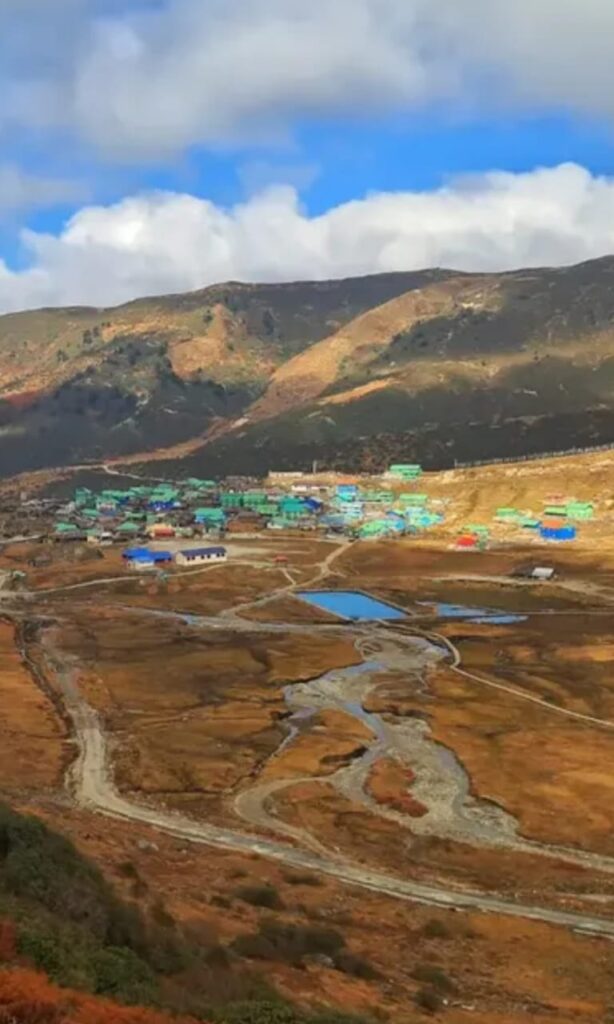
Nathang is nestled at an altitude of 13,500 feet. In the middle of a valley, You can see a cluster of thin houses surrounded by cloudsFrom a distance, this valley may not appear to be a village it resembles more of an army camp or a series of bunkers. However, these are indeed the homes of the villagers, this is a village, Nathang village. This remarkable village stands as one of the highest in Sikkim, at the height of 13500 feet.
Nathang is not only situated at a high altitude but is also an ancient village that served as the first stopping point in India for travelers coming from Tibet along the Silk route, due to its close proximity to both Tibet and Bhutan. Its proximity to both Tibet and Bhutan is significant, even if you are traveling this route, you re mobile phone may connect to network signals from Tibet or Bhutan, will reflect the time zone of Tibet and Bhutan. Due to its altitude, Nathang is home to some yak herders, which is why you often see yaks grazing in the beautiful green meadows. These meadows have been designated as eco-tourism sites to promote silk route tourism. Additional, there is an intriguing structure built in honor of the history of the silk route.
Mini Potala Palace:-
From a distance, it resembles a monastery and is a replica of the Potala palace in Tibet. When viewed from afar, it appears to be a large monastery, but upon closer inspection, you realize it is a miniature replica. There are no doors or windows, it is constructed by joining boards and stones. I can easily access its first, second and third floors. It is such a cute little monastery. Nathang is home to its own monastery, overlooking the entire Nathang valley. While the entire valley exudes a sense of peace,, there’s something particularly about this place.
There is a unique army temple not far from Nathang, distinguished because it is dedicated not to a deity, but to a soldier. “The Harbhajan Baba Temple”.
This temple was built in honor of Harbhajan Baba, a soldier who continues to perform his duty even after martyrdom. In 1968, Harbhajan Baba was martyred during an incident while on duty, but despite extensive searches, his body could not be found. A few days later, one of his comrades had a dream in which Harbhajan baba revealed the location of his body and rifle. While this story is difficult to believe, it become remarkable when his body and rifle were indeed discovered at the same location he had indicated in the dream. Additional, it is said that some soldiers have experienced dreams in which Harbhajan Baba provides then with critical information about enemy operations. Sometime, on duty soldiers experience a sudden jolt while sleeping. Keeping these moments in mind, the army constructed a beautiful memorial temple in his bunker to honor his memory every morning, his uniform is carefully placed, and his bed is prepared as a tribute to him. This temple serves as a testament to the feeling of a true patriot whose life has ended, but his patriotism remains alive.
Kupup Lake:-
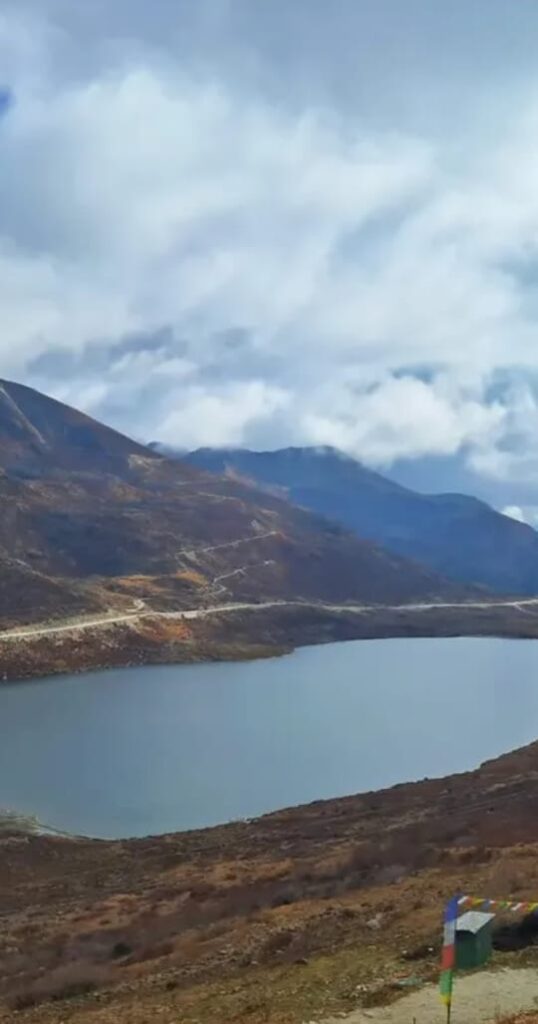
There are several lakes along the Silk route near Nathang, notable for their unique shapes. One such lake is Kupup Lake, which is also known as Elephant lake due to its resemblance to an elephant.