This is one of the most revered temple dedicated to God Shiva. And it is one of the five Punjabi budha St temple this temple is particularly related to Agni or fire and the Shivalinga here is known as agni lingam. The name Arunachala itself means Hill of red fire with Aruna meaning red and achala meaning Mountain so now let’s go to the temple this place is busting with fascinating stories Divine energy and centuries.
History:-
The vast temple complex covers over 25 acres and is known for its massive entrance towers (gopurams), beautiful sculptures, and stunning architecture. There is a fascinating history behind this temple. Once, God Vishnu and God Brahma argued over who was supreme. To teach them a lesson, God Shiva appeared as a massive pillar of fire, known as the Agni Lingam, and challenged them to find its beginning or end.
God Vishnu transformed into a boar and dug deep into the earth, while God Brahma took the form of a swan and flew upwards. After searching far and wide, neither could find the limits of the Agni Lingam, and they finally accepted the supremacy of God Shiva. This pillar of fire then became the Arunachala Hills, which are now seen as a direct form of Lord Shiva himself.
At the request of God Brahma, God Vishnu, and other devotees, God Shiva then created a lingam here for ritualistic worship. This is the exact lingam we see in the main temple today, worshipped by millions over the centuries. Over time, this sacred place has attracted many saints and sages, including Rishi Patanjali, Tirugnana Sambandar, and most famously Sri Ramana Maharshi, who meditated here inspired by its powerful spiritual energy.
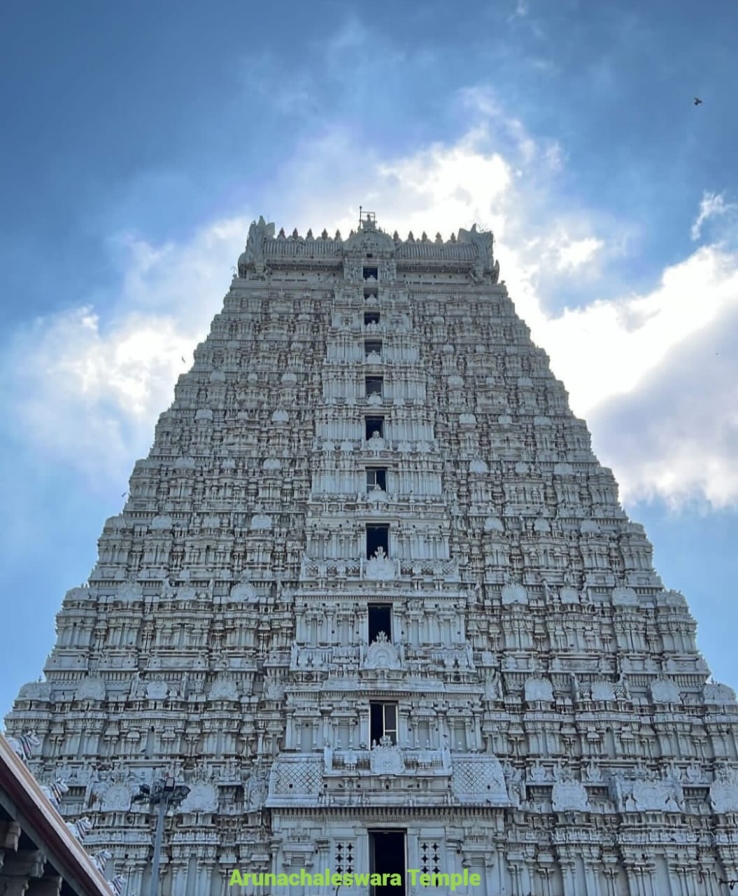
It is believed that walking around the hill, known as Giripradakshina (or Giri Parikrama), is like walking around Lord Shiva himself. The temple is also known for its towering gopurams (gateway towers). There are nine in total, with four outer gopurams and five inner ones. The tallest and most prominent is the Raja Gopuram, also known as the Eastern Gopuram.
Raja Gopuram:-
Raja Gopuram is the main gopuram, also known as the Eastern Gopuram. The construction of this grand gopuram was started by Krishna Raya of the Vijayanagar Empire in 1516 CE and was completed by S.E. Payak. Standing at a towering height of 217 feet, it is covered with intricate carvings that tell countless stories.
Now, we are walking from the Raja Gopuram to the second gopuram. As we walk through the Car Street, we can see the main wall of the temple on one side. Above the wall, Nandi motifs are beautifully carved.
Now, we have reached the second gopuram, which is called the Tianan Gopuram.
Thirumanjana Gopuram:-
It is established in the southern direction. The Thirumanjana Gopuram refers to the ritual holy bath (Abhishekam). Through this gate, holy water is brought for the deities’ rituals in the inner sanctum. The third gopuram is called the Pey Gopuram.
Pey Gopuram:-
Pey means ghost in Tamil but don’t worry there’s no connection with the ghost with this. T it was originally called peri a gopuram meaning large gopuram before the other Towers were built over time the name was short to P gopuram.
This Tower is partially damaged so devotees cannot enter through this gate.
Amman Aman Gopuram:-
The fourth outer wall gopuram was not built by a king, but by a woman named Amal. She was deeply devoted to Lord Shiva and left her village to live in Thiruvannamalai, dedicating her life to Him.
One day, she noticed that the northern gopuram of the temple was incomplete, so she decided to take on the task herself. Amal began gathering donations from the people of Thiruvannamalai and managed to fund the construction of the gopuram. When she ran out of money, she paid the workers with sacred ash, known as vibhuti, and they accepted it out of respect for her devotion.
The current structure of the temple is over 1300 years old, with contributions from various dynasties such as the Cholas, Pandyas, Hoysalas, and the Vijayanagara Empire.
Murugan Temple:-
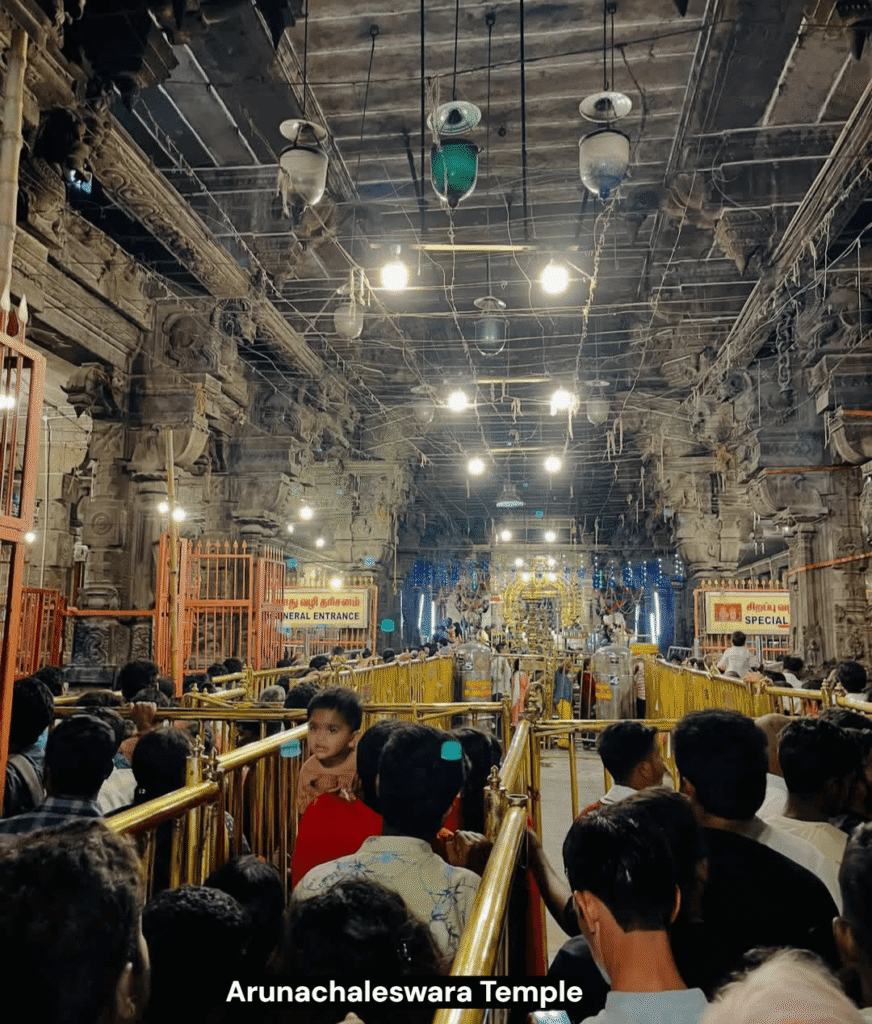
As we enter, on our left we see the beautiful Katu Ilar Murugan Temple, dedicated to Lord Muruga (Subrahmanya), the son of Lord Shiva and Goddess Parvati.
According to Temple history:-
The temple history dates back to the reign of King Prauda Maharaja in Talay. A man named Sambandan, who was jealous of Saint Arunagirinathar’s popularity, challenged him to prove his devotion by calling upon God Muruga. In response, Arunagirinathar sang a devotional song, and amazingly, Lord Muruga appeared from within a pillar. Because of this miracle, Murugan in this temple is known as “Katu Elinar,” meaning the Murugan who appeared.
Behind the temple is a mandapa called Vapu Mandapa. The Vapu festival, also known as the bangle-wearing ceremony for the goddess Unnamulai (Goddess Adi Parashakti), is held here. Beside the temple, there is a hidden murti of Lord Shiva depicted as meditating on Mount Kailash.
Shiva Ganga:-
Shiva Ganga Tirtha is named after the river in Kailasa, the sacred abode of Lord Shiva. The water from this tank is used for the holy bath of the temple deities. Near the Shiva Ganga tank, there is a small shrine dedicated to Lord Ganesha, known as the Shiva Ganga Vinayaka.
Kalyana Sudar Temple:-
Behind this shrine is the Kalyana Sundara Temple, dedicated to Lord Shiva and Goddess Parvati. Apart from the main deities, there are several Naga sculptures located on the left side of the temple. To the left, you will also find the first Kalyana Mandapam of the temple. Adjacent to it stands another beautiful mandapam adorned with intricate carvings. These carvings depict various deities, including Lord Krishna, Lord Hanuman, Lord Shiva, Goddess Parvati, Lord Rama, Lord Narasimha, Lord Vishnu, and other detailed artistic figures.
On the right side of the temple stands one of the smaller gopurams, known as the Vallala Maharaja Gopuram. It was built by the Hoysala king Ballala between 1318 CE and 1343 CE.
To the left of this gopuram, you can find the Gopura shrine and the Arunagiri Mandapam. Inside, there is a magnificent idol of Lord Murugan along with his consorts, Goddess Valli and Goddess Devasena. Saint Arunagirinathar is also depicted at his feet, offering prayers.
In front of the temple stands a magnificent idol of Nandi Bhagwan, locally known as Pandi. This idol is housed in a four-pillared mandapam on a raised platform, facing the main temple. The Nandi idol is about 6 feet long and was built by Vallala Maharaja. A special ritual called Pradosha Puja takes place during twilight, during which special ceremonies are performed for the idols of Lord Shiva, Goddess Parvati, and the Nandi deity.
Behind the right side of the Sri Kattu Murugan Temple lies the impressive Thousand Pillar Mandapam, which reflects the architectural style of the Nayak period. Here, one can see sculptures depicting Lord Shiva’s Tandava (cosmic dance).
Patala Lingum Temple:-
This underground shrine is well known for its connection to Sri Ramana Maharshi in his youth. Ramana Maharshi meditated for many years in front of the Lingam in this temple, which is now a revered site associated with him
Valala Maharaja Gopuram:-
This is the main temple area. After entering, on our left, we find a unique temple dedicated to God Kal Bhairav, the god of time and a fierce form of Lord Shiva. The idol has eight arms and stands about 4 feet tall. On the temple ceiling, we can see paintings of Arunachala Hill, a Shiva Linga, and other forms of God Bhairav. Right next to this temple is the second sacred tank of the temple, called Brahma. There are also four small shrines dedicated to Lord Shiva and Lord Ganesha.
Address:-
Pavazhakundur, Tiruvannamalai, Annamalai R.F., Tamil Nadu 606601